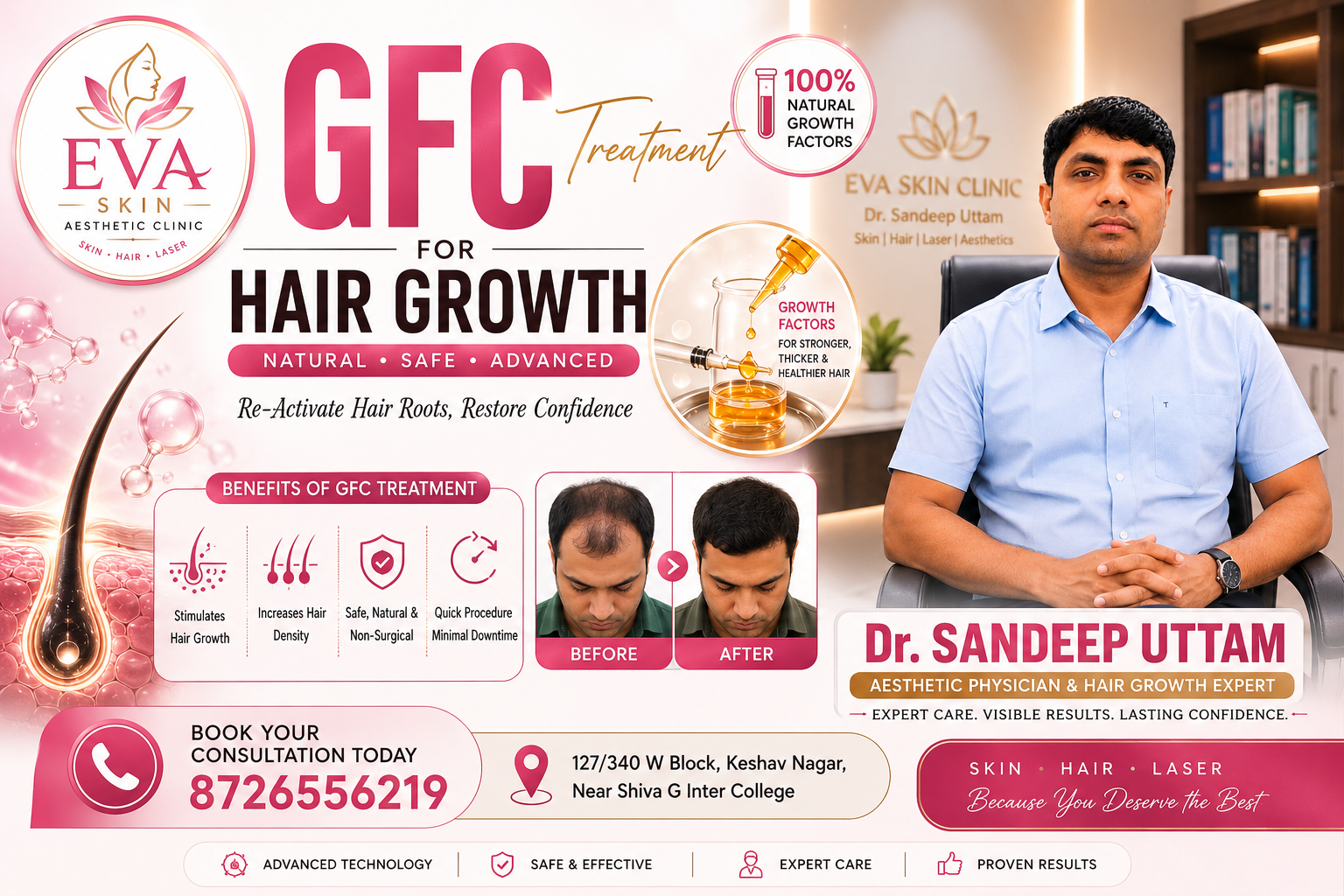
Hair thinning and hair fall can affect both appearance and confidence. While occasional hair shedding is normal, persistent hair loss may indicate an underlying condition that needs proper evaluation. One treatment option that has gained attention in hair restoration is GFC treatment for hair regrowth.
GFC, or Growth Factor Concentrate, is a procedure that uses growth factors derived from a person’s own blood. These growth factors are prepared and then applied to the scalp through injections, with the aim of supporting hair follicles and improving the hair-growth environment.
If you are considering GFC for hair loss, understanding how it works, who may benefit, and what to expect can help you make a more informed decision.
What Is GFC Treatment for Hair Regrowth?
GFC treatment (Growth Factor Concentrate) is a regenerative approach used to support hair growth in selected cases of hair thinning.
The process generally involves collecting a small amount of the patient's blood and processing it to concentrate specific growth factors. The prepared concentrate is then administered into areas of the scalp affected by hair thinning.
Growth factors are naturally occurring proteins involved in processes such as tissue repair and cellular communication. In hair treatment, the goal is to create a more supportive environment for existing hair follicles.
However, GFC is not a guaranteed cure for every type of hair loss. The suitability and expected response depend on factors such as the cause, pattern and duration of hair loss.
How Does GFC Help With Hair Regrowth?
The main objective of GFC treatment is to support weakened or miniaturised hair follicles.
Depending on the individual's condition, GFC may help by:
Supporting the scalp environment around hair follicles
Encouraging activity of existing hair follicles
Potentially improving hair thickness over time
Supporting healthier-looking hair growth
Addressing early or moderate hair thinning in appropriate candidates
It is important to understand that regenerative treatments generally work best when viable hair follicles are still present. Completely inactive or scarred follicles may respond differently.
Who May Be a Candidate for GFC Hair Treatment?
GFC may be considered for people experiencing certain forms of non-scarring hair loss, particularly when hair thinning is still developing.
A dermatologist may evaluate factors such as:
Pattern of hair loss
Hair thinning can occur in different patterns. Male-pattern and female-pattern hair loss, diffuse thinning and other conditions can have different causes and treatment approaches.
Duration of hair loss
Early evaluation can be useful because prolonged hair loss may lead to greater follicular miniaturisation.
Scalp and general health
Conditions affecting the scalp or overall health may contribute to hair shedding. Identifying these factors is an important part of choosing appropriate treatment.
Individual expectations
GFC is intended to support hair growth, not necessarily restore the exact density a person had years earlier. A realistic treatment plan should be based on the individual's diagnosis and condition.
What Happens During GFC Treatment?
The exact protocol can vary according to the clinic and the patient's needs. In general, the process may involve:
Consultation and scalp assessment – A dermatologist evaluates the pattern and possible cause of hair loss.
Blood collection – A small amount of the patient's own blood is collected.
Preparation of GFC – The blood sample is processed to obtain a growth-factor concentrate.
Scalp administration – The prepared concentrate is delivered to selected areas of the scalp.
Follow-up – Progress is monitored and further treatment, if appropriate, is planned according to the individual's response.
Because hair grows slowly, changes should not be judged immediately after treatment. Hair-regrowth treatments usually require appropriate follow-up and patience.
GFC vs Other Hair Loss Treatments
There is no single treatment that is suitable for every person with hair loss.
Depending on the diagnosis, a dermatologist may consider different approaches, which can include medical treatment, procedures or a combination of options.
The important first step is identifying why the hair is falling out.
For example, hair shedding caused by nutritional deficiencies, hormonal changes, certain illnesses, scalp conditions or temporary stress may require a different approach from hereditary pattern hair loss.
This is why consulting a skin specialist in Kanpur before starting a hair-regrowth procedure can be helpful.
Is GFC Treatment Safe?
Because GFC is prepared from the patient's own blood, it is generally considered an autologous treatment. Nevertheless, scalp injections are still a medical procedure and should be performed using appropriate clinical protocols.
Temporary effects such as:
Mild redness
Tenderness
Swelling
Discomfort at injection sites
may occur after scalp injections.
Your dermatologist can explain the potential risks and whether GFC is appropriate for you based on your medical and scalp assessment.
When Should You See a Skin Doctor for Hair Loss?
Consider consulting a dermatologist if you notice:
Hair loss continuing for several months
Noticeable widening of the hair parting
Receding hairline
Increasingly visible scalp
Sudden or excessive hair shedding
Patchy areas of hair loss
Itching, scaling or inflammation of the scalp
Hair loss accompanied by other unexplained symptoms
Early assessment can help distinguish normal shedding from a treatable hair-loss condition.
GFC Treatment in Kanpur
If you are looking for information about GFC treatment for hair regrowth in Kanpur, a professional dermatological assessment should come before choosing a procedure.
At EVA Skin Clinic in Keshav Nagar, Kanpur, patients can discuss their hair-loss concerns and understand whether a particular treatment approach is appropriate for their individual condition.
Rather than choosing a procedure based only on advertisements or before-and-after photographs, it is better to have the cause and pattern of hair loss assessed by a qualified medical professional.
Frequently Asked Questions About GFC Hair Treatment
1. What does GFC stand for in hair treatment?
GFC stands for Growth Factor Concentrate. It is prepared from the patient's own blood and used in selected hair-loss treatments to support the hair-growth environment.
2. Is GFC treatment suitable for everyone with hair loss?
No. Hair loss has many possible causes, and GFC may not be appropriate for every condition. A dermatologist should assess the cause and pattern of hair loss before recommending treatment.
3. How long does GFC take to show results?
Hair growth is a gradual process, so results are not usually immediate. The timeline can vary between individuals depending on the underlying condition and response to treatment.
4. Is GFC the same as a hair transplant?
No. GFC and hair transplantation are different procedures. GFC aims to support existing hair follicles, while a hair transplant involves surgically relocating hair follicles.
5. Does GFC permanently stop hair loss?
GFC should not be considered a guaranteed permanent solution. Hair loss can have ongoing causes, and long-term management may require additional medical treatment or follow-up.
6. Can GFC be used for early hair thinning?
It may be considered in selected cases of early or moderate hair thinning, depending on the diagnosis and presence of viable hair follicles.
7. Where can I consult a skin specialist for hair loss in Kanpur?
People in Kanpur looking for a skin doctor or hair-loss consultation can consult a dermatologist at EVA Skin Clinic, Keshav Nagar, for an assessment of their individual concerns.